

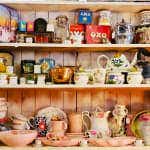
Ah, Teapots! The Remarkable Weinstock Collection Heads to Bonhams
From whimsical animal shapes to remarkable personal histories, Bonhams’ 18th-century teapots have stories to tell.
“Ah…teapots!”
That was pottery dealer Garry Atkins' reaction when Anna Burnside, Specialist and Head of Sale, British Ceramics and Glass at Bonhams, told him the auction house would be selling the Bennett and Judie Weinstock Collection.
We can hardly blame him.
Among the treasures assembled by the celebrated Philadelphia interior designers are more than 150 18th-century teapots, including vessels shaped like squirrels, camels, and ripening fruit. Others bear royal portraits or patterns with political associations. Some are so wonderfully peculiar that it's easy to forget they were originally intended for making tea.
The collection extends well beyond teapots, encompassing English ceramics, furniture, sporting pictures, and decorative objects gathered over decades.
Bonhams will offer the collection in two sales. The Bennett & Judie Weinstock Collection, Part I will be held live in New York on October 20, 2026, beginning at noon EDT. Part II is an online auction running October 11–22, offering additional pieces from the couple's Philadelphia home.
For collectors of early British pottery, the teapots alone provide plenty to explore.
A Passion for Collecting
Bennett and Judie Weinstock were internationally recognized interior designers whose work extended far beyond Philadelphia. Honored in Architectural Digest's AD100 list, the couple was known for interiors that combined the traditions of English country houses with an exuberant appreciation for color and pattern, and their own home reflected those interests.
According to Ms. Burnside, their son, Robert Weinstock recalled that his parents believed objects should inspire conversation and bring people together. Their collection was never meant to be admired only through the glass of a display cabinet. The Weinstocks lived among their treasures and enjoyed sharing them with visitors. Their fascination with 18th-century British pottery is particularly evident in the astonishing variety of teapots they acquired.
Ms. Burnside particularly admires the variety of techniques represented in the collection, including Staffordshire solid agate pottery, made by folding differently colored clays together to create swirling patterns throughout the vessel. She also draws attention to the salt-glazed stoneware, some left undecorated to showcase its crisp molded details, and others brought to life with brilliantly colored enamels.
The collection is a reminder that Georgian potters were capable of considerably more than producing the familiar round teapot.
Storytelling Teapots
Among the more intriguing offerings in Part I is a documentary creamware teapot dated 1772 and inscribed with the name of Captain William Beale of Bridgwater, Somerset.
Decorated with sponged manganese and green coloring, the teapot bears an inscription picked out in blue identifying “Capt Willm Beale in the Bridgwater Casell 1772.” Its intertwined handle and leaf-molded spout are attractive details, but the inscription is what makes this particular vessel so interesting.
According to Bonhams' catalog research, William Beale was born in 1739 into a family involved in Bridgwater's maritime commerce. His name appears in commercial court records during the 1770s, although the title of captain has not been confirmed in those records.
The reference to Bridgwater Castle adds another historical connection. The castle was largely destroyed during the English Civil Wars, and its former grounds subsequently became part of the town's Georgian commercial and residential development.
Whether Beale ordered the teapot himself or received it as a gift is not established in the catalog information, but its inscription preserves a small piece of local history that might otherwise have disappeared.
The teapot carries an estimate of $2,500–$3,500.
Another Part I offering, a large Wedgwood creamware teapot dating to about 1770, demonstrates an entirely different approach to decoration.
Its round-bellied body is covered in multicolored vertical bands of chintz decoration, painted in the Rhodes workshop. Remarkably, the pattern continues onto the cover, requiring careful attention to maintain the design across the two separate pieces.
The teapot has a distinguished collecting history, having belonged to the Donald Towner and David Zeitlin collections. It was also exhibited in Philadelphia in May 1980 as part of a celebration marking the 250th anniversary of Josiah Wedgwood's birth.
Estimated at $1,200–$1,800, it is a particularly appealing example of the decorative possibilities of creamware.
Teapots with Political Leanings
Not every decorative pattern was chosen simply because it was attractive.
A Staffordshire salt-glazed stoneware teapot dating to approximately 1750–60 features a striking tartan pattern painted in pink, green, and blue. Its dark crabstock handle, spout, and finial contrast sharply with the colorful plaid.
Bonhams associates the decoration with Bonnie Prince Charlie and the Jacobite cause, the movement that sought to restore the Stuart dynasty to the British throne. The teapot dates to the years following the Jacobite rising of 1745 and the defeat of Charles Edward Stuart's forces at Culloden in 1746. Tartan had become closely associated with the Highland supporters of the Stuart cause, making the decoration particularly interesting in its historical context.
Whether its original owner intended to express political allegiance cannot be established, but the design provides a fascinating connection to one of Britain's most turbulent periods.
The teapot, estimated at $3,000–$5,000 in Part I, was formerly in the Clare Lees Collection and subsequently handled by D. M. & P. Manheim.
Another Jacobite-associated teapot appears in Part II.
Dating to about 1760, this Staffordshire salt-glazed stoneware example features pink Jacobite roses and green foliage against a finely painted black fish-scale ground. Placed alongside the tartan teapot, it demonstrates how differently potters could approach decoration associated with the same political movement.
Royalty also found its way onto the Georgian tea table.


A Staffordshire creamware commemorative teapot features King George III on one side and Queen Charlotte on the reverse, accompanied by patriotic inscriptions.
A Staffordshire lead-glazed creamware commemorative teapot dating to about 1785 features King George III on one side and Queen Charlotte on the other. The king's portrait is accompanied by the inscription “GOD SAVE THE KING,” while the queen's side bears a corresponding patriotic inscription. The handle and spout project from opposite sides of the molded head, turning the royal portrait into a functional teapot.
Bonhams notes similarities between the king's portrait and designs used on ceramics commemorating Admiral Lord Rodney. A related loving cup in the National Maritime Museum at Greenwich bears comparable patriotic imagery.
It's a wonderful example of how potters adapted familiar public figures to objects intended for the home.
A Squirrel, a Camel, and a Pear
The potters' imaginations were certainly not limited to politics or portraits.
Among the most charming pieces in Part I is an exceptional Staffordshire solid agate squirrel teapot dating to approximately 1750–55.
The squirrel sits upright, holding a nut between its paws, with its head forming the removable cover. A spout projects from the body, while a curved handle completes the vessel. The animal's marbled appearance was created by folding cream and chestnut-brown clays together before pressing the material into a mold. Unlike a painted pattern, the swirling colors are part of the clay itself.
Bonhams compares the resulting appearance to polished elephant tooth.
The squirrel has a noteworthy collecting history. It was illustrated in Frank Tilley's 1957 book Teapots and Tea and was formerly in the collection of the Rev. C. J. Sharp. A handwritten label suggests a possible earlier connection to the Shand Kydd Collection, although that provenance has not been established. A comparable solid agate squirrel teapot is known from Temple Newsam House.
Estimated at $6,000–$9,000, the Weinstock example is a remarkable survivor of an unusually ambitious ceramic design.
Then there's the camel.
Dating to about 1745, this large Staffordshire white salt-glazed stoneware teapot depicts a recumbent camel carrying an elaborate hexagonal howdah. The molded decoration includes a knight in armor and Chinese architectural scenes. The animal wears a detailed harness, while the handle is modeled as a biting snake or lamprey. Even the lid is unusual, with floral decoration and a finial resembling a Turkish head.
At approximately 7½ inches high and nine inches long, the camel is considerably larger than many of the other teapots in the collection. Bonhams identifies a comparable example in the Fitzwilliam Museum and a related redware version illustrated in one of Jonathan Horne's catalogs. And yet, for all its elaborate modeling, this whimsical creature was designed to serve tea.
The potters' ingenuity also extended into the fruit bowl.
A Staffordshire lead-glazed earthenware teapot dating to about 1760–65 takes the form of a ripening pear. Standing just 4½ inches high, the Whieldon-type vessel is mottled in green, ochre, and brown. Its cover incorporates a looped stalk, while a brown-glazed twig forms the handle. Overlapping leaves create the spout, and additional molded foliage decorates the body.
The teapot is an example of trompe l'oeil, an artistic approach intended to make one object resemble another.
A very similar example is in the Burnap Collection at the Nelson-Atkins Museum of Art. Bonhams also identifies related sugar boxes, suggesting that the playful pear design was not necessarily limited to teapots. Estimated at $5,000–$8,000 in Part I, the little pear is exactly the sort of imaginative pottery Burnside had in mind when describing the collection's fruit-shaped vessels.
An Old Teapot, a New Home
Of all the pieces in the collection, one has a history that might be difficult to top. Known as “Norah's Teapot,” a large Whieldon-type punch pot dating to approximately 1765–70 became something of a celebrity after an appearance on the BBC's Antiques Roadshow in 1988.
The nine-inch-tall vessel features vertical stripes of gray, brown, green, and ochre, with a snake-headed spout adding an unusual detail. But its appearance is only part of the attraction.
Norah Ambrose of Merseyside brought the pot to an Antiques Roadshow recording, carrying it in a box with the vessel wrapped in a towel. Generations of her family had used the old pot for making tea. Eventually, however, its considerable size made it inconvenient, and it spent years stored in a box on top of a wardrobe.
When ceramics expert David Battie examined the vessel, he recognized it as a rare 18th-century Staffordshire punch pot and valued it at more than £5,000. Norah was astonished.
The pot subsequently appeared at Sotheby's London on October 18, 1988, where it sold for £14,300. The proceeds enabled Norah to purchase her council house. An old family teapot, once relegated to the top of a wardrobe, had helped her become a homeowner.
The story became one of the memorable discoveries associated with Antiques Roadshow, and Norah later returned to the program.
Bennett and Judie Weinstock acquired the pot through antiques dealer Alistair Sampson. Clearly, they appreciated its history as much as its ceramic qualities. According to Bonhams, the couple kept a newspaper clipping recounting Norah's story inside the pot.
Norah's Teapot is estimated at $6,000–$8,000 in Part I of the auction.
More Discoveries in the Online Auction
The online Part II auction offers another opportunity to explore the Weinstocks' fascination with early British pottery. While Part I includes several of the collection's more elaborate and highly valued pieces, the online sale provides additional possibilities for collectors working with different budgets.
One Staffordshire salt-glazed stoneware teapot dating to about 1760 features an unusual pink scroll-and-dot ground, decorated with green foliage and flowers.
The round body vessel measures just 4¼ inches high. Its decoration includes a large tulip, while the reeded spout and loop handle retain the familiar shape of a mid-18th-century teapot. The piece previously appeared in a 2008 Sampson & Horne exhibition catalog.
Another Staffordshire example, dating to about 1755, demonstrates how utterly lovely a more restrained palette could be.
This Whieldon-type creamware teapot features a translucent gray glaze splashed with green and ochre. Applied flowering branches provide raised decoration, while a flower-shaped finial completes the lid. Bonhams cites a comparable example illustrated in Robin Reilly's Wedgwood, Volume I, published in 1989.
A Yorkshire creamware teapot from the late 18th century takes a different approach, both in shape and subject.
Its cylindrical body is decorated with colorful cartouches. One side depicts Cupid, while the reverse features two hearts tied with a ribbon above the inscription “Love Unites Us.” At just four inches high, the little teapot combines a relatively simple form with a decidedly romantic message.
Also appearing in Part II is a William Greatbatch creamware teapot dating to about 1780.
The six-inch vessel features a pierced scalloped gallery around its lid, with printed and polychrome enamel decoration illustrating scenes from the biblical parable of the Prodigal Son.
One side depicts The Prodigal Son Receives His Patrimony, while the reverse shows The Prodigal Son Taking Leave. The decoration turns the teapot into a storytelling object, with successive scenes from a familiar biblical narrative.
Bonhams references a similar form illustrated in David Barker's 1991 study, William Greatbatch, A Staffordshire Potter.
A Collection Meant to Be Enjoyed
Bennett and Judie Weinstock clearly appreciated fine craftsmanship, but their collecting interests went well beyond technical excellence. They were drawn to objects with personality, whether a squirrel clutching a nut, a royal portrait adapted into a teapot, or an enormous punch pot with an unforgettable story.
It's easy to imagine the conversations these teapots inspired in the Weinstocks' Philadelphia home.
And somewhere among all those remarkable ceramics sat a pot that once helped a woman buy her house.
Surely that was a story worth telling.
Auction Information
The Bennett & Judie Weinstock Collection, Part I
Live auction, October 20, 2026, noon EDT
Bonhams, New York
The Bennett & Judie Weinstock Collection, Part II
Online auction, October 11–22, 2026
Bonhams, Massachusetts
If Teapots are Your Cup of Tea: