

Castlecliff: The Talked-About Jewelry
Often overlooked but richly creative, Castlecliff jewelry blends historic inspiration, bold design, and surprising value, making it a rewarding hunt for collectors who love under-the-radar vintage pieces.
As a rule, Castlecliff doesn’t create a lot of buzz among collectors. Even so, there are some of this company’s designs that I find completely enchanting. Some of them, in complete honesty, are just as interesting as pieces made by other more popular names. One appealing aspect of how they fly under the radar is that you can usually buy these beauties for less than brands everyone else is trying to snag.
Another thing I like about tracking down Castlecliff is that the more unusual designs can make up a unique and intriguing collection. Plus, sometimes it can be more fun to hunt something a bit more elusive—a real treasure. Intrigued? I’ll fill you in on some of Castlecliff’s history as a manufacturing jewelry company, including a couple of tidbits that make this a brand worth talking about.
Castlecliff History in Brief
Castlecliff got its start in New York City in 1918 when Clifford First and Joseph Bobley started the firm. The jewelry marked Castlecliff found today, however, was made from 1941 onward. During the World War II era, they followed the path of many companies, marketing jewelry created with materials beyond plated base metal, such as plastics and wood, along with sterling silver. These pieces are not easy to find these days.
The post-war years saw the company welcome a new head designer. “In the 1950s, William Markle became lead designer at Castlecliff, and his architecturally trained eye set a fanciful tone for the brand, drawing inspiration from a plethora of eras—most notably Gothic, Art Deco, and the Renaissance era,” according to the Castlecliff website. Another mark used by the company in the late 1940s and early 1950s is Castlemark. Since obtaining materials was no longer an issue, rhinestones, glass beads, and simulated pearls were all used in abundance to create an array of eye-catching designs.
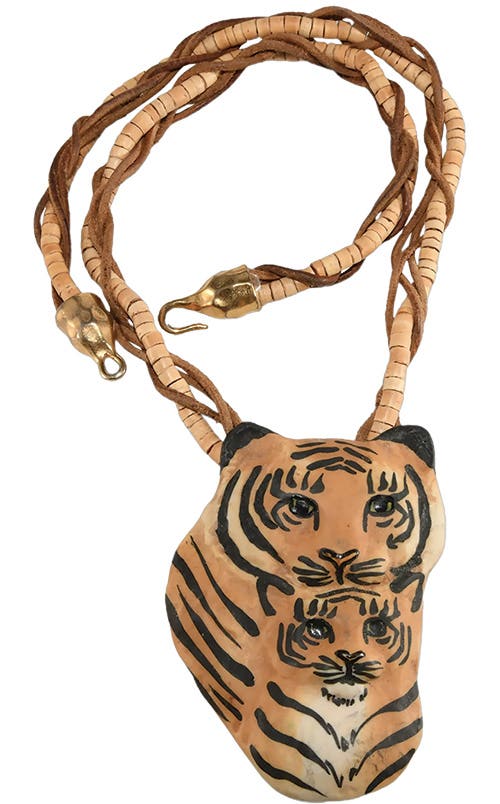
A new era was ushered in at Castlecliff in 1970 with the arrival of Lawrence Vrba. I’d have to agree with the Castlecliff website’s description of him as “one of the greatest jewelry designers of the 20th century.” He went on to work for Miriam Haskell and create masterpieces under his own brand, but while at Castlecliff for two years, he drew inspiration from historical references, including Pre-Columbian artifacts, to design some of his brand’s most recognizable pieces. These include statement-making pendant necklaces and brooches decorated with large, colorful cabochons. They aren’t rare by any means, but these styles do have a following among Vrba devotees.
By 1977, Castlecliff had become part of Carnegie Industries Co., and a collaboration with Ann Klein was noted during that timeframe. Then, in the 1980s, the Castlecliff brand was associated with Lucian Piccard Industries, according to information provided by jewelry historians on the Costume Jewelry Collectors Int’l website.
Currently, Castlecliff is doing business in New York City under new ownership. Stephanie Schwallie, who worked designing jewelry for Vera Wang’s private label, Isaac Mizrahi’s catwalk pieces, and J. Crew’s vintage-look collections, is now leading the revived company. One main difference now—beyond the jewelry looking completely different than vintage styles marked Castlecliff—is the brand’s commitment to using upcycled and existing materials with sustainability in mind, which means metals are melted down and reused, and vintage stones and deadstock are upcycled. Additionally, all Castlecliff jewelry is still made in New York City, a boon for the fashionable set seeking American-made contemporary designs.
More About Vintage Castlecliff Jewelry
From the late 1940s through the 1960s, Castlecliff used the tagline “The Talked-About Jewelry” in its advertising campaigns. Looking through those ads is an excellent way to explore some of the pieces the company has made. Several of them—like a wide hinged bangle bracelet decorated with a collage of rhinestones in different shapes and sizes called “Pagan”—are fan favorites among collectors. Chances are you’ll discover a few surprises, too.
For instance, if you’re lucky enough to find one of the charm bracelets marketed by Castlecliff in the late 1930s (which could easily be mistaken for a 1950s example), you’d note the French motifs and nods to royalty among the charms inspired by the Gothic cathedral Sainte-Chapelle in France, where Louis IX frequented.
Then there’s the “For Love or Money” brooch made of sterling silver featuring a movable scale that appeared in a 1945 edition of Vogue magazine. On one side of the scale, you have Cupid, and on the other side, two coins with dollar signs—a sassy nod to the age-old dilemma between following the head or the heart in matters of love and marriage. Occasionally, you may run across other sterling silver pieces marked Castlecliff, but they’re definitely not run-of-the-mill.
Continuing the journey through Castlecliff’s advertising, it’s clear that the company’s designers were inspired by history and culture. Overall, however, trends popular from decade to decade are represented very clearly in their products. They produced rhinestone jewelry in classic styles from the 1940s through the 1960s that rival those of other popular brands sold during the same period.
Plenty of gold-plated daywear collections were also sold. From large hoop earrings in 1960 to gold-colored brooches with brushed finishes several years later, these pieces competed with styles introduced by designers such as Napier, Trifari, and Monet during the same period. They also created their own iteration of animal bracelets, including a large jaguar bangle, which was a bit ahead of the curve in 1954. Beaded necklaces with coordinating earrings were also promoted from the late 1940s into the mid-1950s, with additional styles available beyond those featured in vintage ads.
One of the differences between Castlecliff jewelry and styles sold by other brands is that the quality varies slightly more. Some pieces are top-notch, while others lack the crisp details and finishing that advanced collectors seek. The company wasn’t as prolific either, so you might have an online marketplace selection of hundreds of Castlecliff designs in comparison to the thousands by Trifari or another one of the heyday giants. Nevertheless, there are some real gems to be discovered, and they’re indeed worth talking about.
Pamela Wiggins Siegel has been buying, selling, and collecting costume jewelry for more than 30 years. She is the author of Warman’s Costume Jewelry (Krause Publications) and the co-founder of Costume Jewelry Collectors Int’l, an organization dedicated to hosting events and providing educational resources for collectors. Visit her online at www.chicantiques.com and www.cjci.co.
You may also like: