

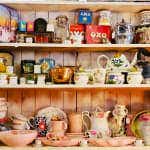
Milk Glass Is on the Move
Once a familiar sight in Grandma’s china cabinet, milk glass is finding a place in today’s vintage-inspired interiors, and much of it is still surprisingly affordable.
For years, milk glass has been easy to overlook. Once a fixture in china cabinets and on dressing tables, the opaque glassware became so plentiful on the secondary market that even attractive vintage pieces could often be picked up for little more than pocket change.
That may be precisely what makes milk glass worth watching now.
Today’s interiors are moving away from stark minimalism and toward rooms that look layered, personal, and collected over time. Grandmacore and cottagecore have embraced vintage ceramics, patterned china, old-fashioned florals, and other furnishings once dismissed as dated. Milk glass fits naturally into that mix, whether it is a simple vase filled with garden flowers, an elaborate covered dish displayed on a shelf, or a sculptural piece chosen simply for its form.
And, at least for now, much of it remains surprisingly affordable.
Milk Glass Isn't Just White Hobnail
Mention milk glass and many collectors immediately picture Fenton’s familiar white Hobnail. There is good reason for the association. Fenton introduced Hobnail in the late 1930s, and its white milk glass versions became some of the company’s most recognizable twentieth-century glassware.
But reducing milk glass to white Hobnail overlooks a much larger collecting world.
Milk glass is generally opaque or translucent glass with the milky appearance that gives it its name. Although white is by far the color most closely associated with it, opaque glass was also produced in an assortment of colors, including blue, pink, yellow, brown, and black.
Nor does milk glass need a Hobnail surface. It can be smooth, ribbed, paneled, quilted, beaded, molded with flowers or fruit, or fashioned into elaborate figural forms. Westmoreland alone produced milk glass in such familiar patterns as Paneled Grape, Old Quilt, Beaded Grape, and English Hobnail.
The distinction is worth remembering. Hobnail describes a raised surface treatment, not milk glass itself.
Fenton’s Coin Dot offers another variation. Introduced by 1947, the pattern was produced in several colors as well as French Opalescent, with circles of clear glass emerging from an otherwise opalescent surface.
An American Glass Favorite
Milk glass has a much longer history than the mid-century pieces frequently encountered at estate sales and antique shops.
American glassmakers were producing identifiable examples by the nineteenth century. Pieces by Atterbury & Company, Hobbs, Brockunier & Company, McKee, and other manufacturers date to the 1870s and 1880s, long before Fenton and Westmoreland became the names many collectors associate most closely with milk glass.
Early glassmakers generally called the material “opal” glass rather than milk glass. Many nineteenth-century pieces were also unmarked, making documented forms, patent dates, patterns, and other identifying characteristics especially important to collectors.
And early milk glass was not necessarily white.
Atterbury & Company produced striking opaque colored and marbleized glass, including its well-known animal covered dishes. An antique Atterbury marbleized milk glass hen-on-nest sold for $103.50 in June 2026.
During the twentieth century, companies including Westmoreland, Fenton, Imperial, L.E. Smith, Kemple, Jeannette, Indiana Glass, Anchor Hocking, Mosser, and others produced an enormous variety of decorative and utilitarian opaque glass.
Westmoreland became particularly closely associated with it. Founded in Grapeville, Pennsylvania, in 1889, the company added opal ware to its lines in 1902. Its milk glass production reached its height during the 1940s through the 1960s, when the rich white glass became virtually synonymous with the Westmoreland name.
The company was hardly limited to undecorated white glass. Westmoreland also produced colored, cased, etched, and hand-decorated wares during its long history.
Fenton became another giant of twentieth-century American milk glass, with Hobnail helping establish an association that remains so strong that the terms “Fenton,” “Hobnail,” and “milk glass” are sometimes incorrectly treated as though they mean the same thing.
They don't.
And American opaque glassmaking didn't disappear with those famous factories. Mosser Glass, established in 1971 in Cambridge, Ohio, continues a family glassmaking tradition with both new designs and classic forms.
Fashionable Again and Still Affordable
That distinction may be the most interesting thing happening with milk glass right now.
Vintage-inspired interiors have returned to favor, but ordinary milk glass has not suddenly become expensive. Many recognizable twentieth-century pieces remain within easy reach of beginning collectors.
At a June 2026 estate sale, five assorted pieces of unidentified milk glass sold together for just $8.05. That same month, an assortment identified as Indiana Glass, Westmoreland, and Avon brought only $14.02.
Those aren't the prices of a collecting category already caught in a speculative frenzy.
Instead, milk glass occupies an interesting place in the current vintage landscape. It delivers the authentic old-fashioned character sought by grandmacore and cottagecore enthusiasts without requiring buyers to purchase newly manufactured décor designed to look vintage.
It also gives newcomers room to learn. Collectors can handle pieces, compare patterns, study glass quality and maker’s marks, develop preferences, and even make the occasional purchasing mistake without necessarily spending a great deal of money.
Know What You're Buying
Affordable does not mean every piece of milk glass sitting on a thrift-store shelf deserves to come home.
Age, maker, pattern, form, color, condition, and scarcity can all matter. So can knowing when a maker’s mark is useful and when it isn't.
Westmoreland provides a good example. The company established its W-in-a-keystone trademark in 1912 and replaced it with the familiar intertwined WG trademark in 1946. But not every genuine piece of Westmoreland carries a mark.
Further complicating matters, molds were sold after the factory closed in 1984, and some retained Westmoreland trademarks when used by later manufacturers.
A mark can therefore provide an important clue without necessarily settling the identification by itself.
Older milk glass presents another challenge. Nineteenth-century examples were often unmarked, making familiarity with documented forms, patterns, patent dates, and manufacturers particularly valuable. Even color by itself is not a reliable way to assign a maker.
For collectors, learning the glass can be every bit as important as turning a piece over and looking for a name.
More Than Vases and Tableware
One of the great things about collecting milk glass is discovering just how many forms manufacturers produced.
There are bowls and compotes, pitchers and tumblers, dresser sets and candy dishes, lamps, covered animals, toothpick holders, epergnes, novelty pieces, and advertising ware.
Even an everyday coffee mug can lead collectors in another direction.
But then, you have your show stoppers. I may not be able to pronounce epergne. But I know one when I see it (I own a gorgeous blue milk glass hobnail Fenton epergne as a matter of fact).
What Deserves a Second Look?
Abundance is one reason ordinary twentieth-century milk glass remains inexpensive. A collector does not need to rescue every white Hobnail vase encountered at a garage sale.
Instead, look for pieces that stand apart.
An unusual form or color may deserve closer examination. So may an older example, a less common pattern, an especially well-executed piece, or something retaining an original label. Figural covered dishes, epergnes, advertising pieces, elaborate compotes, unusual tableware, and less frequently encountered decorative forms can offer considerably more collecting interest than the ubiquitous bud vase.
None of those characteristics automatically makes a piece valuable. They make it worth investigating.
Condition matters, too. Chips, cracks, staining, poorly executed repairs, and damage to applied decoration can make an inexpensive piece considerably less appealing when another example may not be difficult to find.
Most importantly, buy something because it is good glass and because you like it, not simply because an algorithm has decided that everybody's grandmother is fashionable this year.
Ahead of the Curve?
No one can say whether renewed decorating interest will translate into substantially higher collector prices. Trends change, and widespread availability remains a reality for many twentieth-century milk glass patterns.
But collecting trends rarely begin when prices rise. Interest comes first.
Right now, milk glass has several things working in its favor. Its forms and textures complement the layered vintage interiors currently in fashion, its history offers plenty for serious collectors to explore, and prices for many pieces remain accessible.
Milk glass is fashionable again, readily available, and much of it won't break the bank.
For collectors, that may make this an especially interesting time to take another look.
Ready to learn more? The National Milk Glass Collectors Society is a natural place to start, with information devoted to opaque glass from a wide range of periods and manufacturers. Fenton enthusiasts can explore the Fenton Art Glass Collectors of America, while the National Westmoreland Glass Collectors’ Club offers an extensive online collection, company history, and resources for identifying Westmoreland glass. And unlike Fenton and Westmoreland, Mosser is still making glass in Cambridge, Ohio. Visit Mosser Glass to learn about the family’s glassmaking history and see what the company is producing today.
Can't get enough collectible glass? Wait, there's more!