

America at 250: American Samoa’s Enduring Island Traditions
As the United States nears its 250th anniversary, American Samoa steps forward, highlighting its deep-rooted traditions, island artistry, and enduring cultural ties within the broader American story.
Each Friday, we’ll be celebrating America’s 250th by exploring one state or territory at a time, uncovering the history, crafts, and Semiquincentennial events that help tell the nation’s story.
A Brief History of American Samoa
Composed of seven islands and atolls in Polynesia, American Samoa is a territory many mainland Americans may never have visited. Characterized by its lush greenery and volcanoes, American Samoa sits in the South Pacific Ocean and is closer to New Zealand than the nearest state, Hawai’i.
Before it was American Samoa, the islands were joined with what is now the self-governing island nation of Samoa and were ruled by a series of Tui Manuʻa, or paramount chiefs. The catalyst for this division was the introduction of colonization to the islands, which began with the arrival of Dutch navigator Jacob Roggeveen in 1722 and ended with the Tripartite Convention between the United States and Germany. This agreement split control of the western islands (modern-day Samoa) to the Central European nation, while the eastern islands (American Samoa) were given to the USA.
Honoring the 250th: American Samoa’s Role in America’s Celebration
Last year, then American Samoa Governor Lemanu Palepoi Sialega Mauga signed an executive order establishing the America250 Commission of American Samoa. Charged with planning programs for the 250th anniversary, the initiative will help shape local celebrations. In a press release for America250, the former Governor explains, “As we commemorate America’s 250th anniversary, we recognize the importance of honoring our past, celebrating our present, and shaping our future.” He continues, “Together, we will showcase the vibrant tapestry of American Samoa’s culture and heritage while reaffirming our commitment to the ideals of freedom, equality, and opportunity.” To learn more about America250 programming, visit america250.org.
American Samoa’s Indigenous Art Heritage
Formed millions of years ago from volcanic activity, the island’s population is primarily Samoan. An important tradition in Samoan culture is fa'a Samoa, a communal way of life that is also reflected in arts and design practices.
Samoan arts are typically made from materials sourced from nature: plant fibers, wood, and the sea. Among the oldest traditions is siapo, a canvas cloth that is made from tapa (bark of the Paper Mulberry tree). It is often painted with patterns inspired by the environment and is used as ceremonial clothing and room decor.
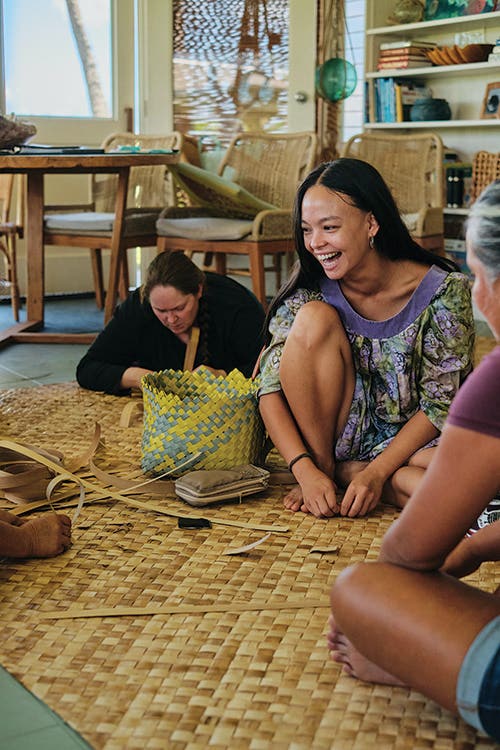
Another example is the ie Samoa or 'ie tōga, a finely woven mat made from palm with fringe on one side that is often made in weaving houses (fale lalaga) by craftswomen. It can take months for an 'ie tōga to be completed, as it involves an intricate process of weaving thin strands together to create a silk-like hand. They are not to be used on the floor; rather, they are reserved for special occasions such as weddings and traditional ceremonies.
Other examples of Samoan arts include woven plant-hand fans known as ili, designed with intricate geometric patterns and shapes; wooden tanoa bowls used to prepare kava; and sculptural wood carvings and war clubs.
There is a growing number of arts and cultural institutions that are working to preserve Samoan heritage. Prominent institutions in American Samoa include the Jean P. Haydon Museum, which houses 650 objects related to Samoan heritage, as well as Fa'asamoa Arts and the American Samoa Council on Arts, Culture, and Humanities.
Among the Samoan diaspora, both within and outside the South Pacific, are institutions such as New Zealand’s Te Papa Tongarewa and the Australian Museum in Sydney that also house numerous historical items related to Samoan cultural heritage.
You may also like: