
A Visual Feast of Los Angeles Potteries
Through stunning photography and firsthand accounts, Erica K. Schisler documents the evolution of a defining name in postwar American serveware.
This book is a visual dessert for those of us (me included) who love the pottery of this era. Erica K. Schisler’s Los Angeles Potteries: A Collector’s Journey through Artistry, Craft, and Heritage serves it up, course after course.
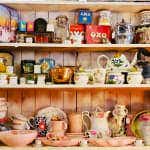
At 304 pages in a square, coffee-table format, the volume is first and foremost a feast for the eyes. The photography is gorgeous—stunning, actually. Glossy canisters gleam under studio lights, figural cookie jars feel playful rather than kitschy, and hand-painted hens, rabbits, and vegetable platters reveal details that mass production often hides. These are familiar forms, but here, they are given room to breathe.
Schisler approaches the subject not as a distant historian, but as a devoted collector. Her introduction frames the story through memory and domestic ritual, grounding Los Angeles Potteries in the lived experience of American kitchens. That perspective continues throughout. This is not just a company history; it is cultural history told through objects that once sat on countertops and dinner tables throughout America.
The book traces the company’s evolution from Los Angeles Potteries to its acquisition by the N.S. Gustin Company and later transformation into Laurie Gates Designs. Interwoven essays and firsthand recollections from those connected to the firm add dimension and credibility: these voices illuminate factory life, family ownership, and the creative energy behind mid-century California ceramics.
Photography is organized by form: serveware, platters, bowls, cookie jars, and novelty pieces, which makes the book easy to navigate. Standouts include whimsical animal cookie jars, 1950s space banks, vegetable-themed platters, and collaborations with designers such as Hedi Schoop. The breadth of material underscores how expansive the company’s output truly was, from practical ovenware to sculptural statement pieces.
A particularly helpful section near the end provides a guide to pottery markings. Schisler addresses mold numbers, signatures, country-of-origin marks, wadding dots, and preservation concerns such as crazing and potential lead glaze. While no complete mold-number catalog survives, the framework offered here gives collectors practical tools for identification and care.
This is not a price guide, nor is it an academic monograph. Instead, it functions as a visual archive and preservation effort. By documenting hundreds of pieces, many of which are from her own collection, Schisler ensures that Los Angeles Potteries and its successor companies are firmly situated within the broader story of postwar American design.
For collectors of California pottery and mid-century serveware, this book fills a meaningful gap. It makes a compelling case that these objects deserve serious attention, not only for their charm, but for what they reveal about regional manufacturing, artistic collaboration, and domestic life.
And thanks to the sumptuous photography, readers do not just learn about pottery; they see it in full color, glaze finish by glaze finish, detail by detail. That alone makes this volume worth savoring.
Where to Buy:
Available at local bookstores, specialty shops, and www.losangelespotteries.com.
You may also like:
Collect.com. Connecting collectors to what matters. Search our collector’s database for services, events, resources, and articles about the collectibles you love.