

Flights of Fancy
Artist David Klein’s TWA aviation posters soared during the Golden Age of Air Travel.
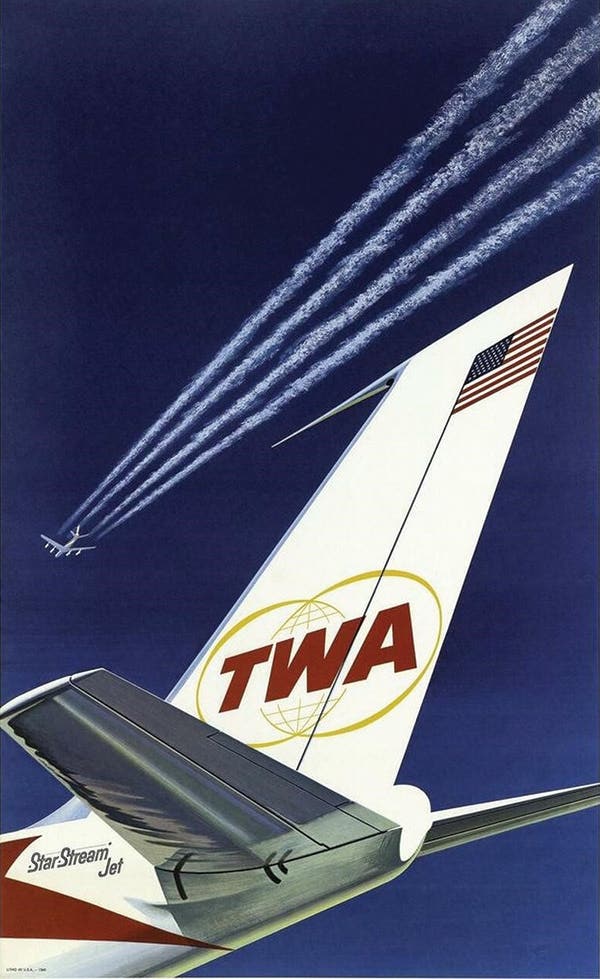
It was all so exciting, so intoxicating, so very, very glamorous.
The Beautiful People, naturally, were the first in line. In the mid-1950s, as the Golden Age of Air Travel soared into rarified heights—streamlined and sophisticated, fashionable and fast—the movie stars and socialites and scions of unimaginable wealth sipped champagne and kissed the friendly skies on extravagant flights of fancy. They hobnobbed around the globe on seemingly endless and elegant adventures: New York to London, to Paris, to Rome, the Riviera, Monte Carlo, Tokyo, and beyond.
Unlike today, when travelers endure invasive security checks, cramped cabins, and unruly passengers, early flights held an enormously romantic appeal. In 1958, Frank Sinatra’s swinging “Come Fly with Me” served as the theme song for the well-heeled passengers taking his upbeat advice to visit far-flung destinations on aircraft like the de Havilland Comet, the Boeing 707, and the Douglas DC-8. Early commercial jet travel was as magical as it was lavish.
“Air travel at that time was something special,” Graham M. Simons, an aviation historian and author, said in an interview with CNN. “The airlines were marketing their flights as a luxurious means of transport, because in the early 1950s they were up against the cruise liners.”
Long before the dream of the internet and well before the dominance of television, travel posters were the main means of advertising this new winged adventure. Posters were pervasive, found in airports, railway stations, travel agencies, airline ticket offices, hotels, and on advertising kiosks in cities around the world.
In the mid-1950s, when billionaire businessman Howard Hughes, the pioneering aviator and eccentric owner of Trans World Airlines (TWA), one of the world’s most progressive and prestigious airlines at the time, wanted those advertising posters to reflect a new era of travel, he turned to David Klein. That decision turned out to be brilliant for business and for the world of advertising art.
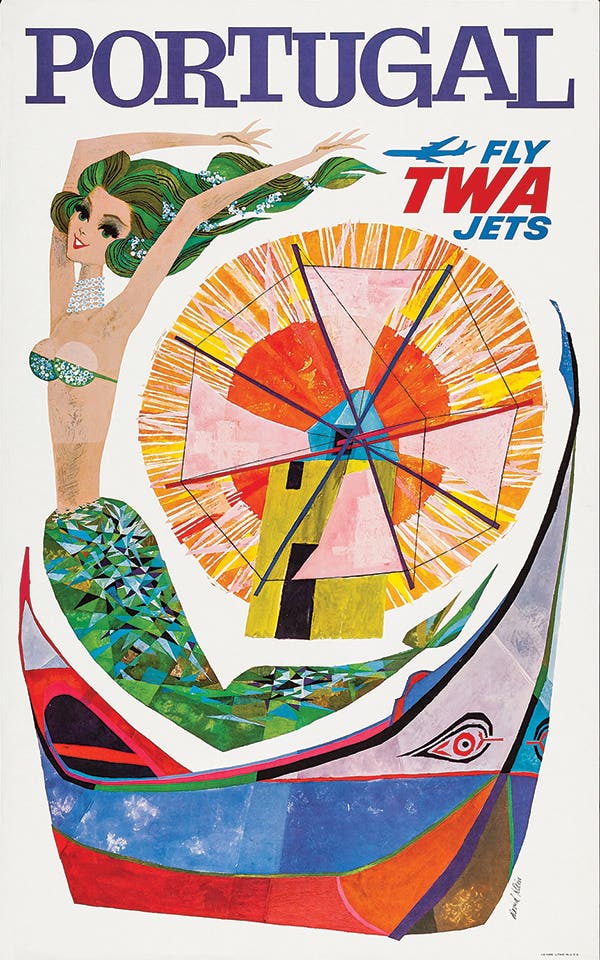
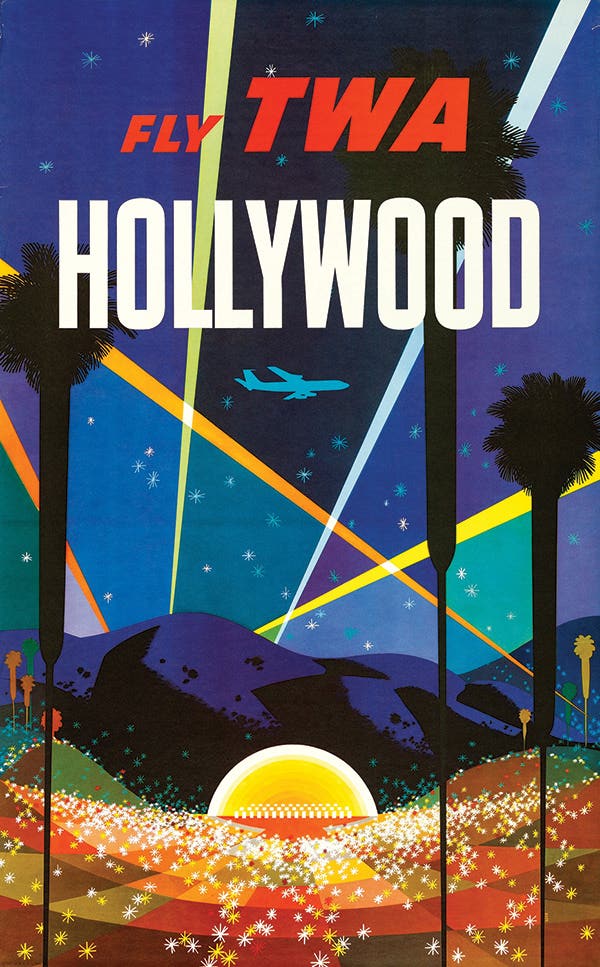
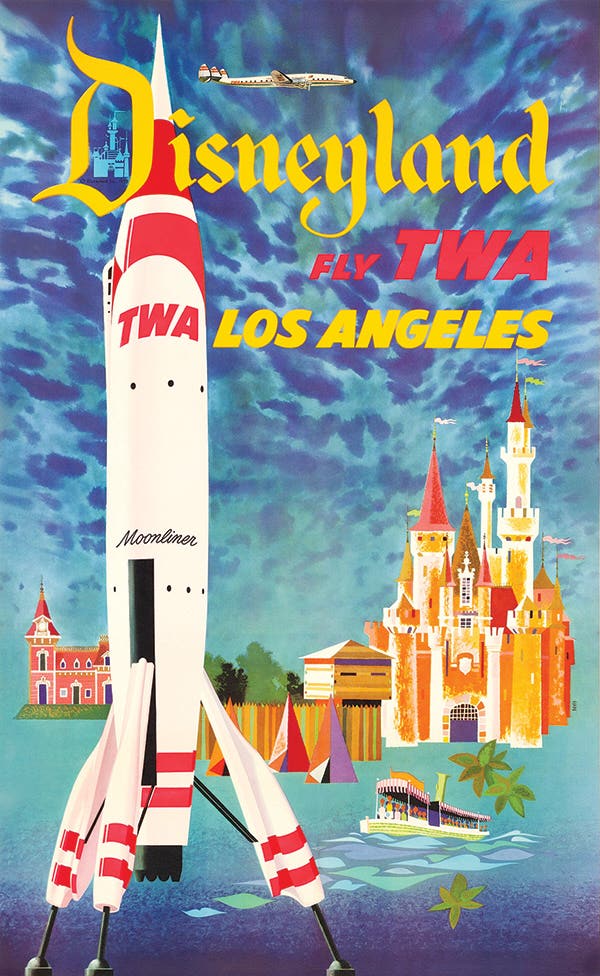
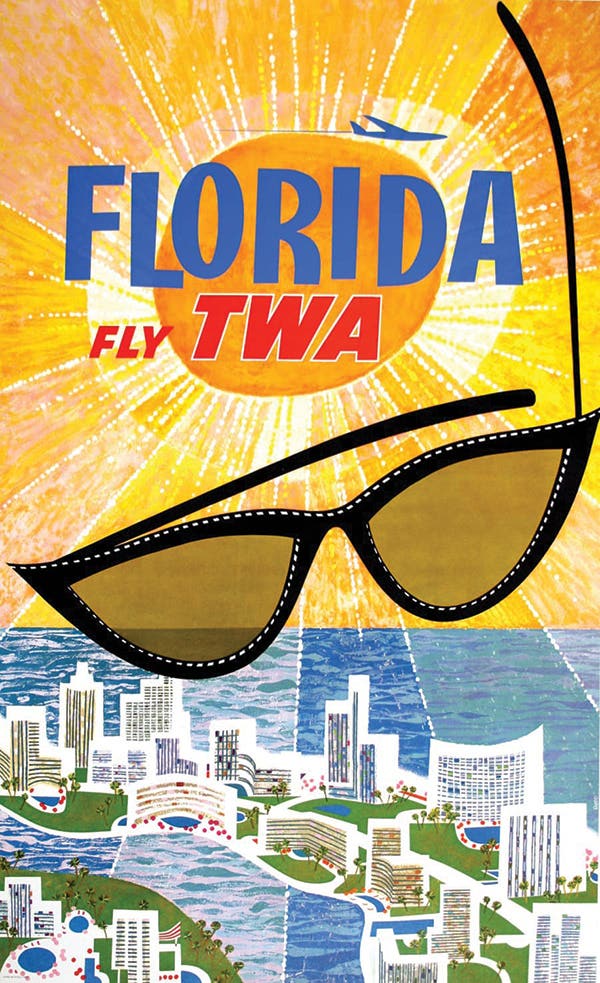
During a ten-year stint with TWA, Klein became “one of the great aviation poster artists,” according to Nicholas D. Lowry, president of Swann Auction Galleries, New York, and director of its Vintage Poster Department. “His work is ubiquitous. And listen, to be fair, not all of his posters are great posters, but his great posters are at the absolute top of desirability and graphic design. His good stuff is as good of Mid-Century Modern design in America as one could possibly hope for.”
Born in El Paso, Texas, Klein studied at the Art Center School in Los Angeles and gained early recognition as part of the California Watercolor Society in the 1930s. Serving in the Army during World War II, he contributed to the war effort by illustrating military manuals and morale-boosting posters.
Swann Auction Galleries
Swann Auction Galleries
After the war, Klein moved to New York City, where he created artwork for Broadway productions, including The Music Man and Cat on a Hot Tin Roof. But it was his work for TWA that cemented his legacy. Klein’s art, a combination of bold colors, abstract shapes, and a dynamic sense of movement, was a perfect fit for the airline and the times.
Untethered by past constraints, Klein captured the exciting potential of air travel in a rapidly modernizing world. From about 1955 to 1965, Klein’s visual language—stripped of excessive text and reliant on form and color—became a template for midcentury travel advertising.
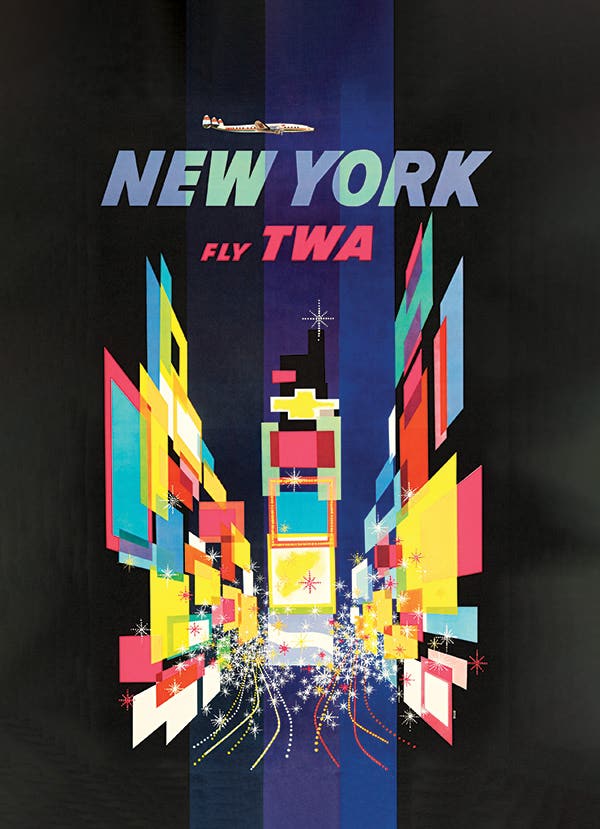
Klein’s impact was immense. His best work, according to Lowry, a longtime appraiser on the popular PBS show Antiques Roadshow, is the artist’s 1956 TWA New York travel poster, a spectacularly vibrant, Day-Glo tribute to Times Square.
“In my opinion it is one of the greatest graphic depictions of Times Square,” Lowry says. “It’s geometric, abstract, providing an almost kaleidoscopic view of this great, bustling intersection. He captures all of the energy; he captures all of the excitement; he captures all of the movement.”
The poster reflects the zeitgeist of flight in the mid-1950s. Despite being, first and foremost, a piece of advertising, Klein’s illustration created a pitch-perfect definition of New York during its Mid-Century Modern moment.
So spectacular was the work that New York’s Museum of Modern Art (MoMA) added Klein’s TWA Times Square poster to its permanent collection a year after its release, a startling acceptance of advertising art into the realm of high design. The poster remains so massively popular and consequential that a first printing of it sold for $25,400 (against a high estimate of $10,000) at Swann in November of 2025, establishing a record for Klein’s TWA work.
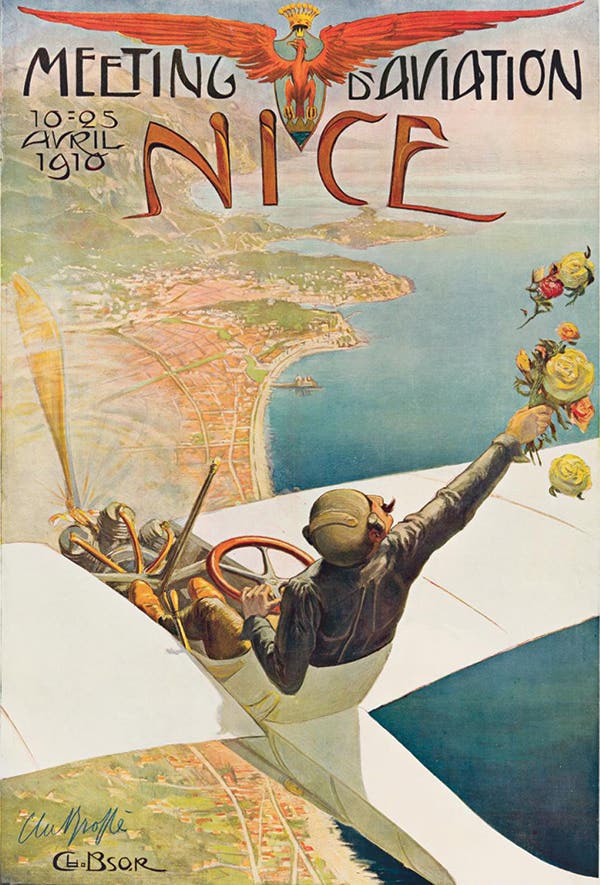
Klein, of course, didn’t invent the aviation poster, but he did change the medium’s message. Almost since the Wright brothers launched the aviation age in 1903 with a 12-second, 120-foot journey at Kitty Hawk, there have been posters celebrating air travel. Perhaps the most fanciful and enchanting of all aviation posters, according to Lowry, is an image from 1910 by Charles-Leoncé Brossé (1871–1945).
The work has a pilot flying in an open-air cockpit, dropping roses on the French Côte d’Azur. In the early days of flight, aviation competitions were all the rage, and Brossé’s poster promotes a fifteen-day extravaganza in the south of France. Its distinction comes from the ingenious, deceptively simple idea of putting the viewer higher up than the plane, looking down toward the ground, Lowry says.
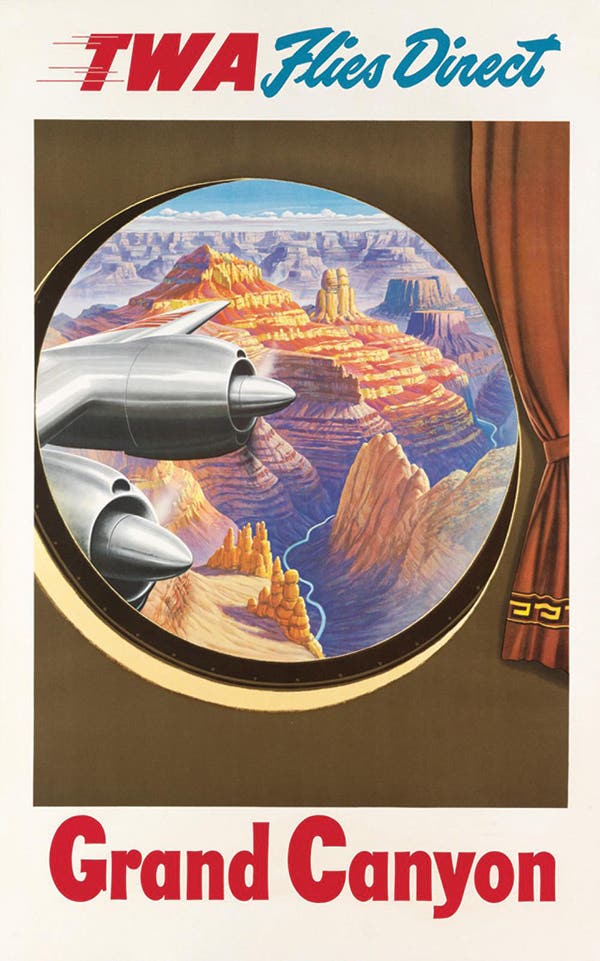
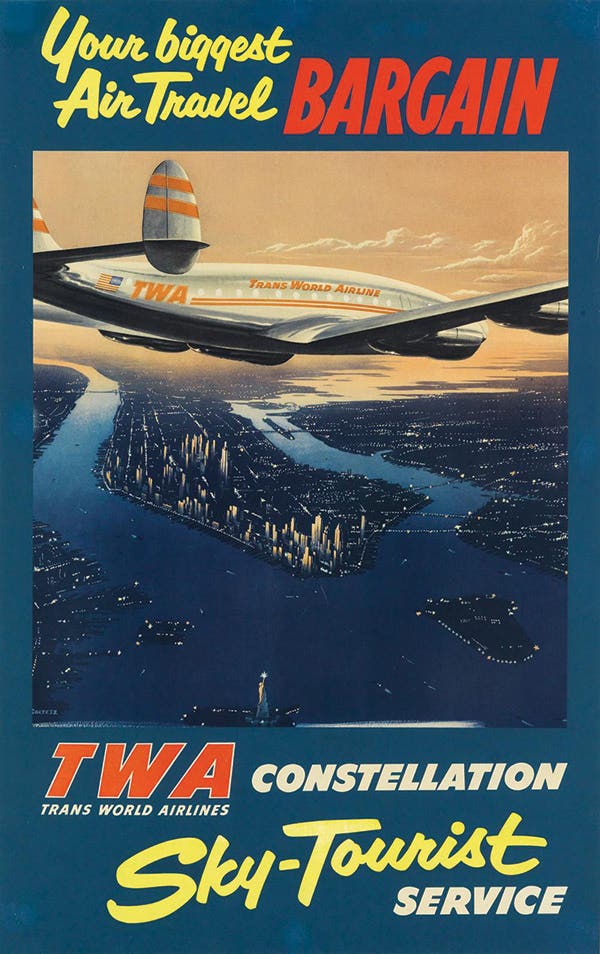
For decades, air travel posters focused on views. TWA’s own early 1950s travel posters showed such things as a bird’s-eye view of the Grand Canyon, seen through the window of a TWA plane. Curtains around the window reflected the more genteel days of air travel. In 1952, the great commercial artist Frank Soltesz (1912–1986) offered a stunning bird’s-eye view of New York City for TWA.
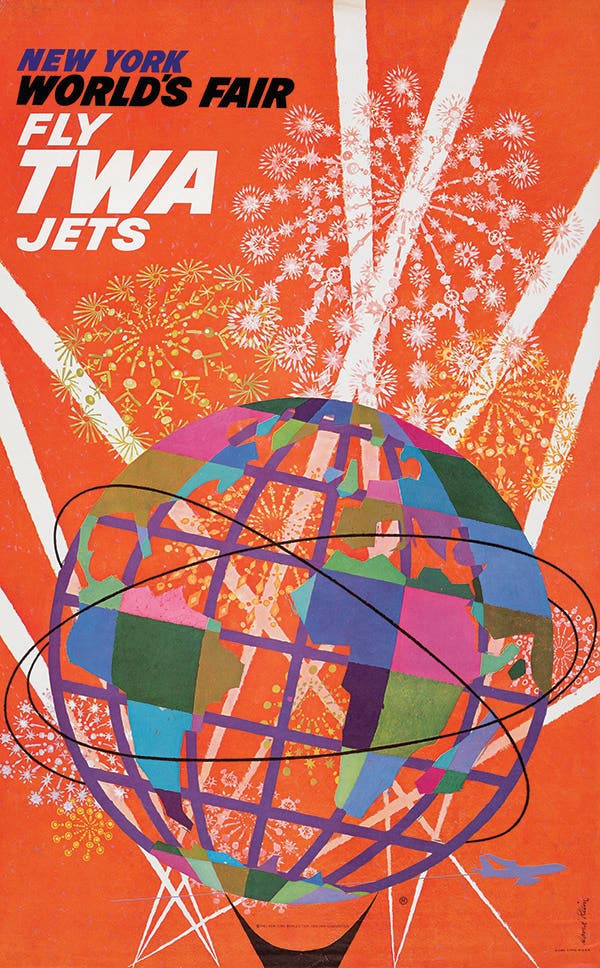
Fly TWA Jets, 1961, $968. Heritage Auctions
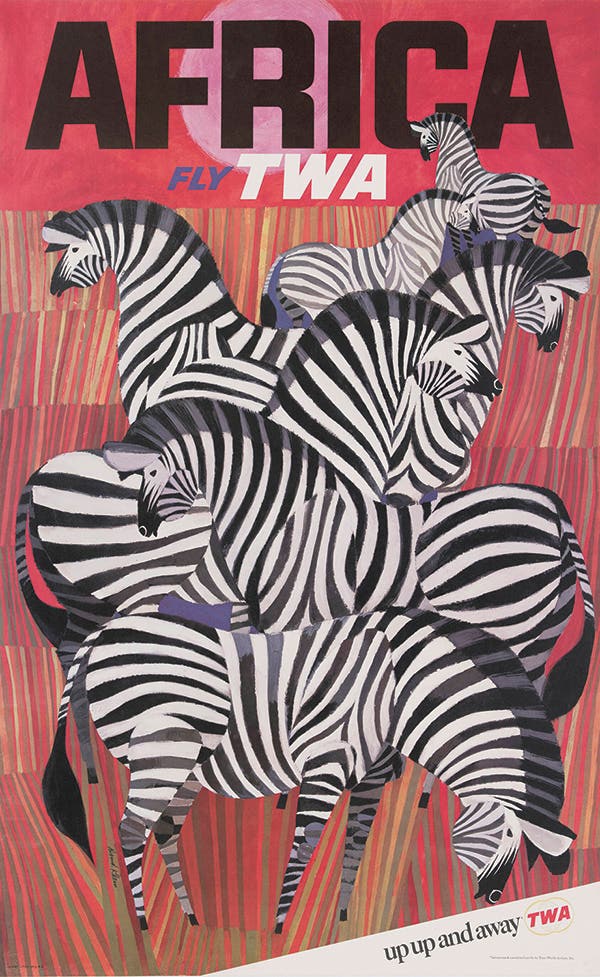
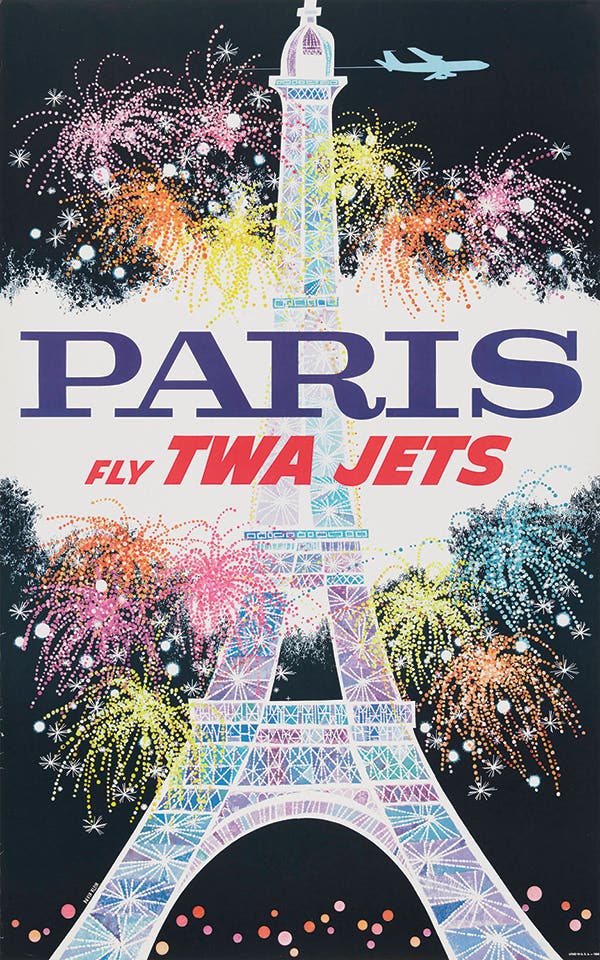
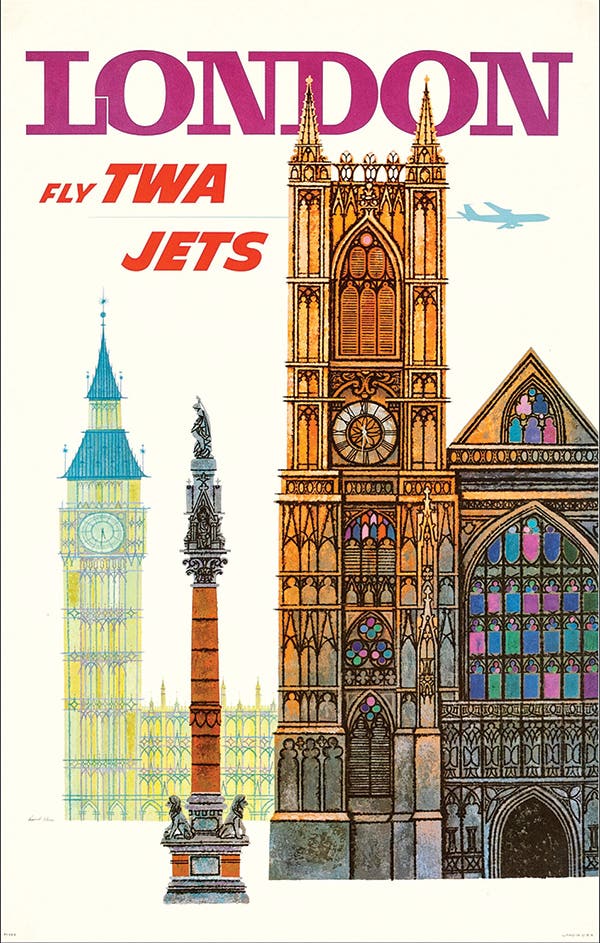
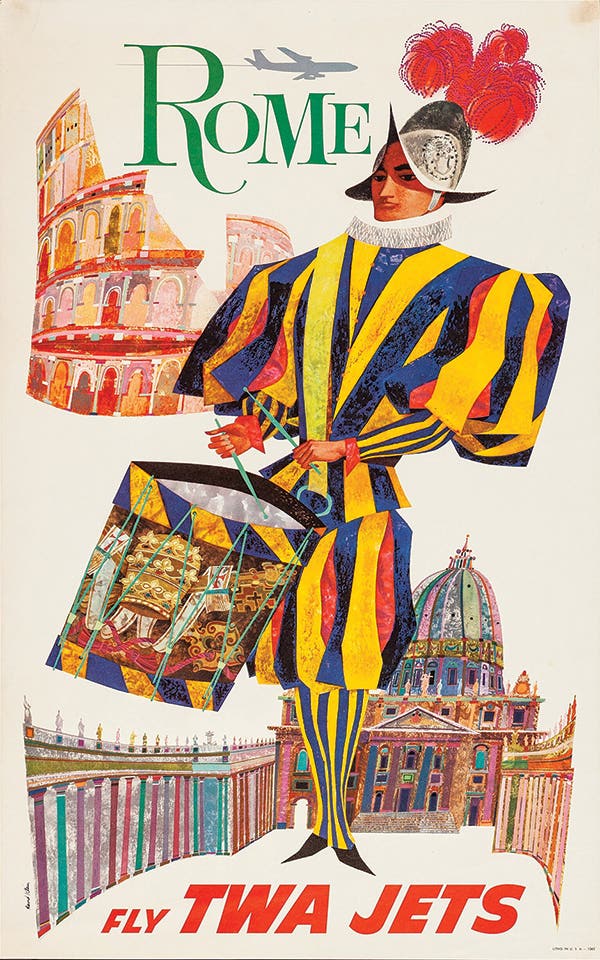
All wonderful work, no doubt, yet it was Klein’s focus on famous destinations (New York, Paris, London, Rome, Portugal, Africa) while using bright colors in a transcendent modern style that defined the state of poster art during the Golden Age of Air Travel. His innovative approach extended to typography, where he integrated bold hand-lettering into the design, creating a seamless fusion of image and text. Klein’s design choices not only made the exotic instantly recognizable but also reinforced the visual impact of the posters.
So instead of views framed by window curtains, TWA’s clientele was assaulted with dazzling destinations that seemed to vibrate with their own electric pulse, thanks to the artist’s considerable talents.
Klein designed dozens of travel posters for TWA during his ten-year tenure. His Fly TWA/Las Vegas poster, circa 1960, captured the early, Rat-Pack era glitter of what was to become Las Vegas’ international fame. The work illustrates the day-and-night nature of Las Vegas, featuring a woman dressed both as a sun-kissed bathing beauty and a glamorous casino gambler. A copy of the poster sold for $2,400 last November at Swann.
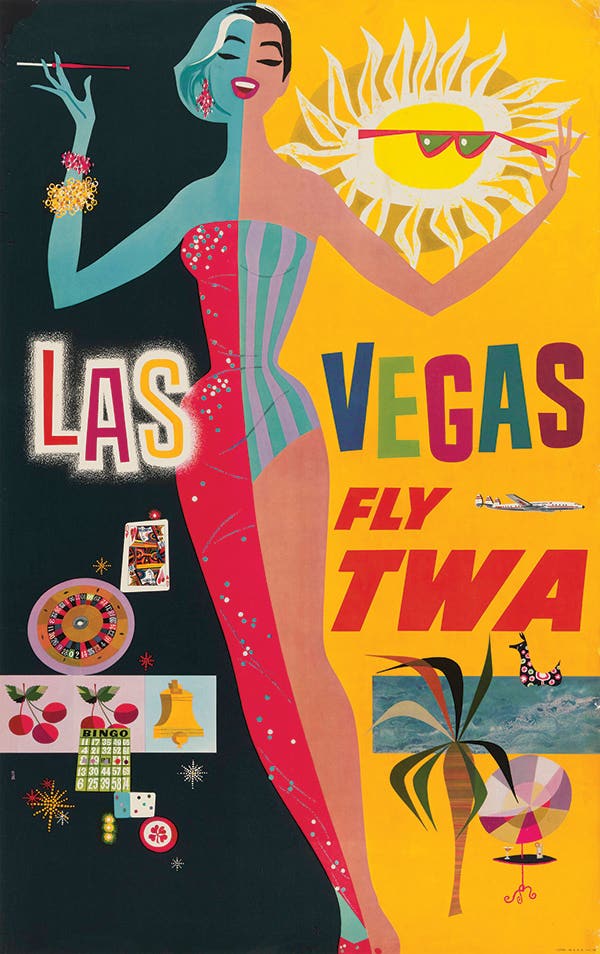
Poster Auctions International
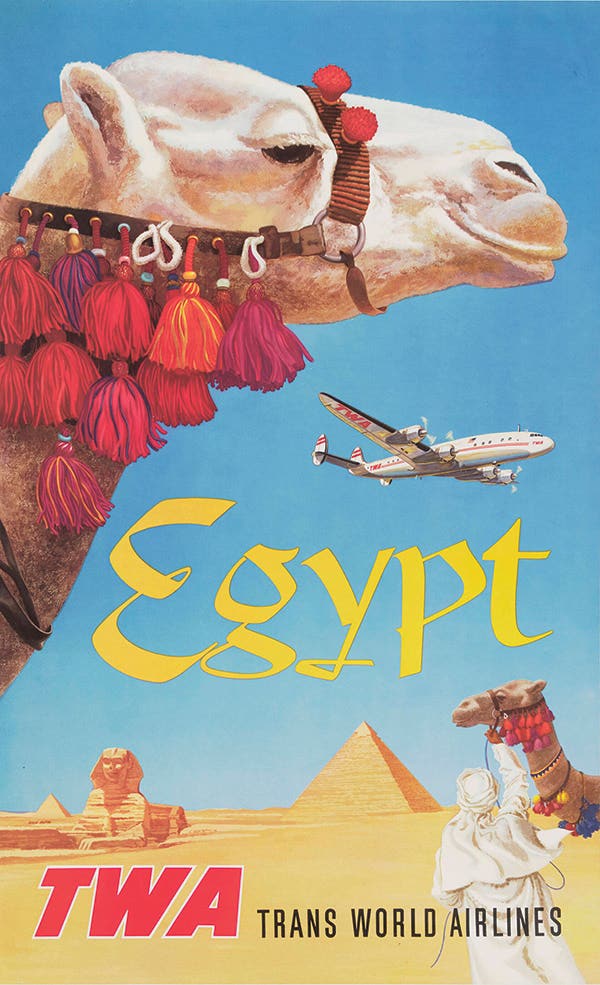
c. 1958, $1,122. Poster Auctions International
Values for Klein’s original posters vary widely depending on destination, rarity, and condition. Most posters at auction fall within the $1,000–$5,000 range, although there are exceptions as the record-setting Times Square work illustrates. Reproductions of Klein’s posters abound; so, if you’re interested in original posters, it’s always good to work with a reputable dealer or auction house to ensure your purchase is authentic.
During the 1970s, the Golden Age of Air Travel, and the grand advertising posters that supported it, faded like jet contrails in the summer sky. Airline deregulation and densely packed jumbo jets fundamentally changed travel. Luxury, comfort, amenities, service, and style were all jettisoned when affordability was prioritized. Glamour was gone, replaced by airlines’ desire for the lowest potential operating cost per seat.
“The reality is that the large aircraft and the capacity they brought along, as well as the industry’s deregulation, changed the whole attitude toward advertising,” says Matthias C. Hühne, the author of Airline Visual Identity, 1945–1975 (Callisto Publishing, 2015). “Prior to deregulation, it was still important to highlight the qualities of an airline, because they could not compete over price. After deregulation, it became only about price.
“By the mid-1970s, the emphasis on advertising had moved away from graphic design expressed in posters and elaborate print advertising over to color television,” Hühne says. “This had really started before, in the 1960s, but the shift from these beautiful posters was more marked by then. What you see after that was not so innovative anymore.”
As for TWA, there was no soft landing. The airline was plagued by problems: the management whims of Howard Hughes, which lasted until 1966; airline deregulation; a disastrous takeover by corporate raider Carl Icahn in 1985; bankruptcies in 1992 and 1995; and the 1996 explosion of TWA flight 800 near Long Island that killed all 230 people on board the Boeing 747, which staggered the company. In December 2001, TWA was acquired by American Airlines’ parent company, and the once-venerated Trans World Airlines was no more.
After his time at TWA, Klein created art for Amtrak and several cruise lines. In 2000, reflecting just how much times had changed, the internet travel booking company, Orbitz, commissioned Klein to recreate the look and feel of his TWA posters for its Planet Earth advertising campaign. Klein, then in his 80s, worked with illustrator Robert Swanson to produce a series of posters that resonated with past glory.
David Klein died in 2005 at the age of 87. Like all great art, however, his work endures, allowing our imaginations to fly first-class to a bygone era without ever leaving the ground.
You may also like:
Collect.com. Connecting collectors to what matters. Search our collector’s database for services, events, resources, and articles about the collectibles you love.

Paul Kennedy is Editorial Director of the Collectibles Group at AIM Media. He enjoys Mid-century design, photography, vintage movie posters and people with a good story to share. Kennedy has more than twenty-five years of experience in the antiques and collectibles field, including book publishing. Reach him at PKennedy@aimmedia.com.